Introduction: The Problem I Couldn’t Ignore
For years, I watched organizations make critical decisions about people, technology, and growth based on incomplete or outdated information. Teams were labeled “high performing” or “under-skilled” without real evidence. Employees were trained without clarity on what capabilities actually mattered. Leaders relied on gut feelings instead of clear insights.
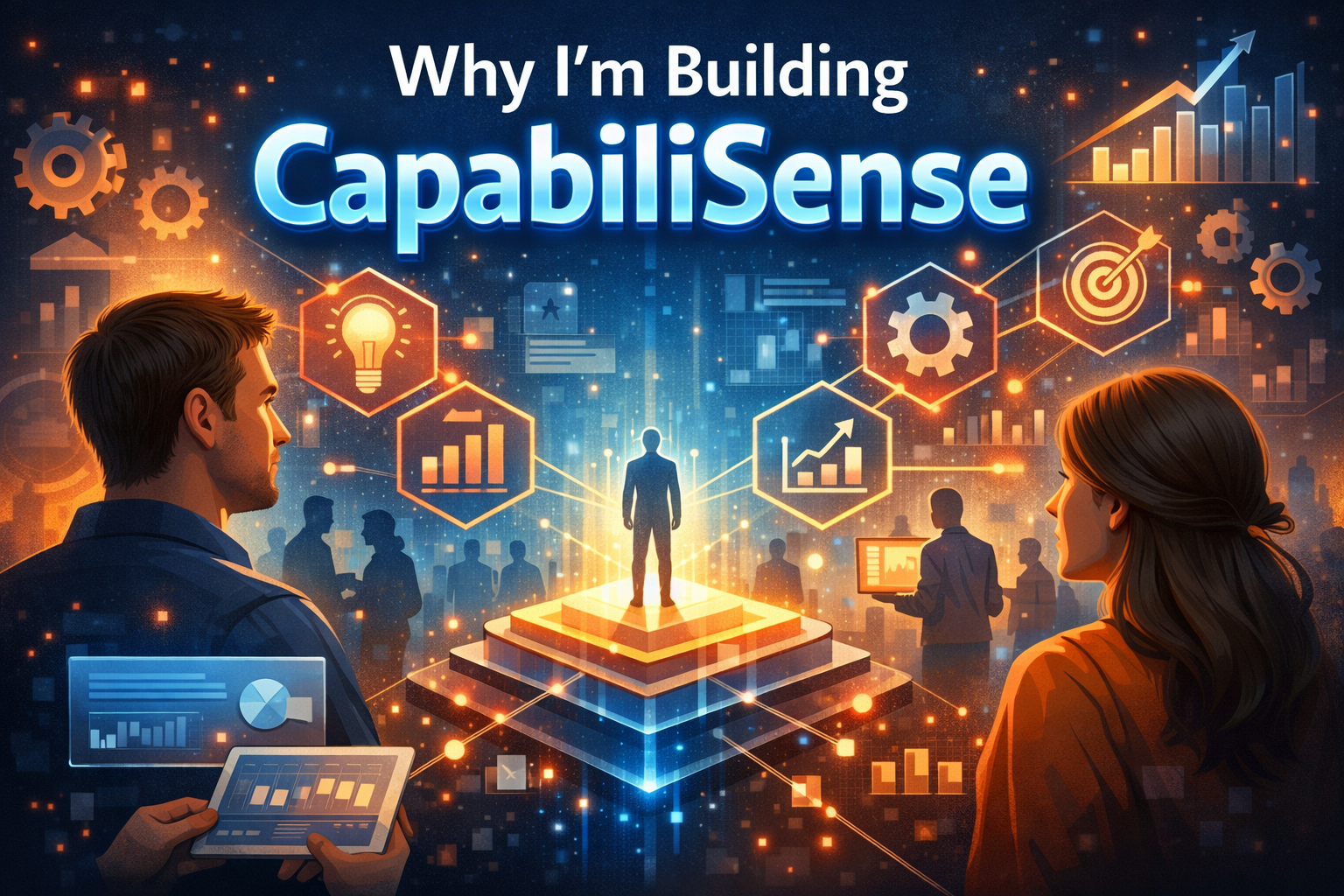
That ongoing disconnect is the real reason behind why Im building CapabiliSense.
CapabiliSense is not an idea born in a boardroom or a trend-chasing startup pitch. It’s a response to a very real, very expensive problem: organizations don’t truly understand their capabilities, and individuals don’t clearly see how their skills align with future opportunities.
This article explains why CapabiliSense exists, what problem it aims to solve, and how it is designed to create measurable, human-centered impact.
Why I’m Building CapabiliSense: The Core Motivation
At its core, CapabiliSense is about visibility. Most organizations believe they know their strengths, but when change hits new technology, new regulations, new markets that confidence quickly fades.
I’m building CapabiliSense because:
- Businesses struggle to map real capabilities, not just job titles
- Employees lack clarity on skill gaps and growth paths
- Learning investments often fail to deliver ROI
- Strategic decisions are made without capability-level data
These issues are not theoretical. They show up as missed deadlines, failed digital transformations, high turnover, and stalled innovation.
CapabiliSense is designed to replace assumptions with insight.
The Capability Gap Most Organizations Don’t See
A capability gap isn’t just about missing skills. It’s the difference between what an organization thinks it can do and what it can actually deliver.
For example, a company may believe it is “data-driven,” but in reality:
- Only a small percentage of teams can interpret dashboards
- Data tools are underused or misused
- Decisions still rely on hierarchy rather than evidence
This gap creates risk. According to global workforce studies, organizations that fail to align skills with strategy are significantly more likely to miss growth targets and fall behind competitors.
Understanding this gap is a major reason why Im building CapabiliSense to make hidden weaknesses visible before they turn into failures.
Why Existing Tools Fall Short
Many platforms claim to solve workforce or capability challenges, but most focus on isolated pieces of the puzzle.
Some track learning completion but not real competence.
Others map job roles but ignore evolving skills.
Many rely on self-assessments without validation.
The result is fragmented insight.
CapabiliSense is built differently. It focuses on capabilities as living systems, not static checklists. Skills evolve, roles change, and business needs shift. A useful platform must reflect that reality.
What CapabiliSense Is Designed to Do
CapabiliSense is being built to help organizations and individuals understand, measure, and develop capabilities in a practical way.
Its core goals include:
- Translating strategy into measurable capability requirements
- Mapping current skills against future needs
- Highlighting critical gaps before they become risks
- Supporting targeted learning and development
- Enabling smarter workforce and technology decisions
Rather than overwhelming users with dashboards, the platform emphasizes clarity and relevance.
A Human-Centered Approach to Capability Intelligence
One of the strongest reasons why Im building CapabiliSense is to humanize capability data.
People are not data points. They are problem-solvers, learners, and contributors. CapabiliSense is designed to support growth, not surveillance.
This means:
- Clear language instead of technical jargon
- Actionable insights instead of raw scores
- Transparency in how capabilities are assessed
- Empowerment for employees to own their development
When people understand where they stand and where they can go, engagement naturally increases.
Real-Life Scenarios That Inspired CapabiliSense
CapabiliSense was shaped by real-world experiences, not theory.
In one organization, leaders invested heavily in new software, only to discover that teams lacked the foundational skills to use it effectively. Millions were spent, adoption was low, and frustration grew.
In another case, high-potential employees left because they couldn’t see a clear growth path. The organization assumed competitive salaries were enough. They weren’t.
These situations highlight why capability visibility matters more than ever.
Why Capability Insight Matters in a Fast-Changing World
Technology cycles are shrinking. Skills that were valuable five years ago may already be outdated. Organizations that rely on static job descriptions struggle to adapt.
CapabiliSense is being built to help answer critical questions such as:
- Are we ready for automation or AI adoption?
- Which teams need upskilling now, not next year?
- Where should we invest in learning for maximum impact?
Without clear answers, leaders are forced to guess—and guessing is expensive.
How CapabiliSense Supports Smarter Decision-Making
Better decisions come from better insight.
CapabiliSense connects capability data to real business outcomes. Instead of asking, “Who completed training?” leaders can ask, “Who can actually perform this task at the required level?”
This shift enables:
- More accurate workforce planning
- Reduced skills mismatch
- Improved project success rates
- Stronger alignment between strategy and execution
That alignment is a major driver behind why Im building CapabiliSense.
Building Trust Through Evidence and Transparency
Trust is essential when dealing with people data. CapabiliSense is being built with transparency at its core.
Users should understand:
- What is being measured
- Why it matters
- How assessments are used
- How data supports growth, not punishment
By focusing on ethical, explainable insights, CapabiliSense aims to build long-term trust with both organizations and individuals.
The Long-Term Vision for CapabiliSense
CapabiliSense is not just a tool. It’s a framework for continuous capability growth.
The long-term vision includes:
- Helping organizations future-proof their workforce
- Supporting individuals in navigating career transitions
- Enabling data-backed talent strategies
- Creating a shared language around skills and capability
In a world where change is constant, adaptability becomes the most valuable capability of all.
Why Im Building CapabiliSense Now
Timing matters.
Organizations are facing talent shortages, rapid digital change, and rising expectations from employees. At the same time, data maturity is improving, making better insight possible.
This convergence makes now the right time.
CapabiliSense is being built to meet today’s challenges while staying flexible for tomorrow’s unknowns.
Conclusion: Turning Capability Insight into Action
The simple truth behind why Im building CapabiliSense is this: clarity changes outcomes.
When organizations understand their real capabilities, they make better decisions. When people understand their strengths and gaps, they grow with confidence.
CapabiliSense exists to bridge that gap between strategy and execution, potential and performance, data and humanity.
If you believe capability insight should be practical, ethical, and growth-focused, CapabiliSense is being built with you in mind.
Follow the journey, explore the vision, and be part of shaping a smarter, more human approach to capability intelligence.
FAQs
What is CapabiliSense in simple terms?
CapabiliSense is a capability intelligence platform designed to help organizations and individuals understand, measure, and develop real-world skills aligned with future needs.
Why is capability mapping important?
Capability mapping reveals the gap between current skills and strategic goals, helping organizations reduce risk and invest in the right areas.
How is CapabiliSense different from traditional skill tools?
Unlike static skill lists or training trackers, CapabiliSense focuses on evolving capabilities, practical application, and decision-ready insights.
Who can benefit from CapabiliSense?
Business leaders, HR teams, learning professionals, and individuals looking for clear growth pathways can all benefit.
Is CapabiliSense focused on people or technology?
CapabiliSense focuses on people first, using technology as a tool to support understanding, development, and better decisions.